Crossing guide
What the Plymouth to Roscoff crossing is like
Published route guidance gives about five hours 15 minutes for daytime travel and roughly eight to eleven hours for overnight sailings. The operating pattern is seasonal and the assigned ship may be Armorique or Pont-Aven. Verify the exact departure rather than relying on a remembered summer timetable.
Leaving Plymouth
Millbay terminal is close to Plymouth city centre, though the last urban roads run slower than a motorway estimate suggests. Brittany Ferries asks pet passengers to check in at least 90 minutes early. Dogs are allowed in the port and terminal here — more flexibility than Portsmouth — with Plymouth Hoe and Devil’s Point useful for a pre-boarding walk.
Before you join the lanes
- Allow more than the sat-nav drive time — port approaches and check-in cut-offs are not motorway estimates.
- Check the booking confirmation for the final vehicle and foot-passenger deadlines; pet travellers often have an earlier one.
- Photograph or download the booking before you travel, because reception in a port queue is unreliable.
- Pack one small bag with medicines, chargers, a change of clothes and dog supplies: car-deck access is normally restricted at sea.
- Save the onward address offline and check whether tolls, low-emission zones or local driving rules affect the road ahead.
The passage
The working duration is about 5¼ hours by day or roughly 8–11 hours overnight. Conditions at the western Channel passage can differ sharply from either harbour, which is why this guide samples three points rather than one coastal icon — a moderate wave with a long swell period feels quite different from short, steep seas. If anyone aboard is prone to seasickness, prepare before departure and choose a cabin position with comfort in mind.
A resilient plan
Select the day or overnight pattern before deciding whether a cabin is essential, because the five-hour day crossing and the longer night service produce very different Roscoff arrival plans. Verify the seasonal timetable. Armorique and Pont-Aven are not interchangeable for every pet preference, so use an alert to reopen the dated booking and confirm the vessel before arranging the Brittany road leg.
Conditions
Weather along the route
Departure
Plymouth departure
- Air / sea
- 17.0°C / 16.9°C
- Wind / gust
- 7.2 kn / 14.4 kn
- Wind direction
- SSW (203°)
- Wave / period
- 1.2 m / 6.9 s
- Wave direction
- SW (219°)
Mid
Western Channel passage
- Air / sea
- 16.2°C / 16.5°C
- Wind / gust
- 15.6 kn / 18.5 kn
- Wind direction
- SW (216°)
- Wave / period
- 2.1 m / 9.3 s
- Wave direction
- WSW (257°)
Arrival
Roscoff arrival
- Air / sea
- 17.8°C / 17.3°C
- Wind / gust
- 9.0 kn / 13.0 kn
- Wind direction
- SW (217°)
- Wave / period
- 1.0 m / 9.2 s
- Wave direction
- W (273°)
Provider data: Open-Meteo (licence); units and three-point presentation normalised by SailSoon.
For planning context only — not for navigation or decisions about whether a sailing will operate. Check Brittany Ferries for official sailing status.
Seven-day passage outlook
| Day | Sea state | Wave | Wind | Gust | Air |
|---|---|---|---|---|---|
| Mon12 OctToday | Moderate | 2.2 m | 21.4 kn | 27.8 kn | 20°C |
| Tue13 Oct | Rough | 2.7 m | 27.4 kn | 36.0 kn | 19°C |
| Wed14 Oct | Moderate | 2.2 m | 14.3 kn | 22.2 kn | 21°C |
| Thu15 Oct | Moderate | 2.4 m | 16.0 kn | 23.3 kn | 21°C |
| Fri16 Oct | Rough | 2.7 m | 24.4 kn | 31.1 kn | 16°C |
| Sat17 Oct | Moderate | 2.1 m | 19.0 kn | 25.3 kn | 15°C |
| Sun18 Oct | Moderate | 2.1 m | 22.9 kn | 33.6 kn | 14°C |
Daily maxima for planning only — not a forecast for any particular sailing, and not a statement about whether a crossing will operate.
Availability
Recently seen cabins
Historical cabin sighting
24 April 2027 · 22:00
Standard (no pets)
Ship shown when seen: Armorique
Observed fare: £203
Observed by SailSoon on 6 October 2026 at 22:36 UTC.
Historical sighting—availability and price may have changed.
Check current availability with the operatorHistorical cabin sighting
24 April 2027 · 22:00
Accessible cabin (wheelchair) · Wheelchair-accessible cabin (2W)
Ship shown when seen: Armorique
Observed fare: £203
Observed by SailSoon on 6 October 2026 at 22:36 UTC.
Historical sighting—availability and price may have changed.
Check current availability with the operatorHistorical cabin sighting
24 April 2027 · 22:00
Pet-friendly cabin · Pet-friendly 2 berth inside cabin
Ship shown when seen: Armorique
Observed fare: £203
Observed by SailSoon on 6 October 2026 at 22:36 UTC.
Historical sighting—availability and price may have changed.
Check current availability with the operatorHistorical cabin sighting
23 April 2027 · 08:30
Pet-friendly cabin · Pet-friendly 2 berth inside cabin
Ship shown when seen: Armorique
Observed fare: £183
Observed by SailSoon on 5 October 2026 at 22:36 UTC.
Historical sighting—availability and price may have changed.
Check current availability with the operatorHistorical cabin sighting
23 April 2027 · 08:30
Standard (no pets)
Ship shown when seen: Armorique
Observed fare: £183
Observed by SailSoon on 5 October 2026 at 22:36 UTC.
Historical sighting—availability and price may have changed.
Check current availability with the operatorHistorical cabin sighting
23 April 2027 · 08:30
Accessible cabin (wheelchair) · Wheelchair-accessible cabin (2W)
Ship shown when seen: Armorique
Observed fare: £183
Observed by SailSoon on 5 October 2026 at 22:36 UTC.
Historical sighting—availability and price may have changed.
Check current availability with the operatorRecent sighting reserved for alerts
Members receive the useful details before a delayed historical example can appear here.
Create an account for member-first alertsRecent sighting reserved for alerts
Members receive the useful details before a delayed historical example can appear here.
Create an account for member-first alertsSeasonal context
Typical conditions through the year
1991–2020 averages — not a forecast. Long-term conditions provide planning context; a particular crossing can be very different.
Departure Plymouth departure
| Month | Air °C | Wind mean / p90 kn | Prevailing wind | Wave mean / p90 m | Period s | Prevailing wave |
|---|---|---|---|---|---|---|
| January | 7.9 | 15.2 / 23.8 | WSW (250°) | 2.3 / 3.7 | 7.7 | WSW (242°) |
| February | 7.5 | 14.2 / 22.9 | W (263°) | 2.0 / 3.5 | 7.6 | WSW (250°) |
| March | 8.1 | 13.1 / 21.2 | W (272°) | 1.7 / 2.9 | 7.3 | WSW (249°) |
| April | 9.4 | 11.6 / 18.9 | W (281°) | 1.4 / 2.3 | 6.8 | WSW (248°) |
| May | 11.7 | 11.1 / 18.2 | WNW (288°) | 1.2 / 2.1 | 6.3 | WSW (246°) |
| June | 14.3 | 10.5 / 16.8 | W (262°) | 1.1 / 1.8 | 6.2 | WSW (251°) |
| July | 16.1 | 10.4 / 16.5 | W (261°) | 1.0 / 1.7 | 5.9 | WSW (254°) |
| August | 16.4 | 10.5 / 16.6 | W (264°) | 1.0 / 1.8 | 5.9 | WSW (253°) |
| September | 15.1 | 11.3 / 18.1 | W (267°) | 1.2 / 2.1 | 6.3 | WSW (253°) |
| October | 13.0 | 13.5 / 21.3 | WSW (237°) | 1.7 / 2.8 | 6.7 | WSW (240°) |
| November | 10.5 | 14.2 / 22.3 | W (262°) | 1.9 / 3.2 | 7.0 | WSW (248°) |
| December | 8.7 | 15.2 / 23.9 | WSW (253°) | 2.2 / 3.7 | 7.4 | WSW (243°) |
Mid-route Western Channel passage
| Month | Air °C | Wind mean / p90 kn | Prevailing wind | Wave mean / p90 m | Period s | Prevailing wave |
|---|---|---|---|---|---|---|
| January | 9.3 | 18.9 / 28.6 | WSW (247°) | 2.9 / 4.6 | 9.0 | W (268°) |
| February | 8.7 | 17.7 / 27.6 | W (263°) | 2.7 / 4.4 | 9.0 | W (273°) |
| March | 9.1 | 16.2 / 25.4 | W (276°) | 2.3 / 3.6 | 8.5 | W (276°) |
| April | 10.0 | 14.1 / 22.9 | NW (312°) | 1.8 / 2.9 | 7.9 | W (277°) |
| May | 11.9 | 13.3 / 21.1 | NNW (330°) | 1.5 / 2.5 | 7.2 | W (277°) |
| June | 14.3 | 12.3 / 19.7 | WNW (283°) | 1.4 / 2.2 | 7.0 | W (274°) |
| July | 16.3 | 12.3 / 19.7 | W (274°) | 1.3 / 2.1 | 6.7 | W (273°) |
| August | 16.8 | 12.3 / 19.5 | W (275°) | 1.3 / 2.1 | 6.8 | W (273°) |
| September | 15.7 | 13.5 / 21.3 | W (277°) | 1.6 / 2.6 | 7.3 | W (278°) |
| October | 13.9 | 15.9 / 24.8 | SW (234°) | 2.1 / 3.3 | 7.8 | W (270°) |
| November | 11.8 | 17.6 / 26.6 | W (260°) | 2.4 / 3.8 | 8.2 | W (271°) |
| December | 10.1 | 19.0 / 28.6 | WSW (251°) | 2.8 / 4.5 | 8.6 | W (269°) |
Arrival Roscoff arrival
| Month | Air °C | Wind mean / p90 kn | Prevailing wind | Wave mean / p90 m | Period s | Prevailing wave |
|---|---|---|---|---|---|---|
| January | 8.9 | 17.1 / 26.3 | SW (229°) | 2.8 / 4.4 | 9.4 | W (281°) |
| February | 8.5 | 16.1 / 25.8 | WSW (247°) | 2.6 / 4.2 | 9.4 | WNW (286°) |
| March | 9.1 | 14.8 / 23.7 | W (263°) | 2.2 / 3.5 | 8.9 | WNW (289°) |
| April | 10.0 | 13.2 / 21.8 | NNW (333°) | 1.8 / 2.8 | 8.1 | WNW (291°) |
| May | 12.0 | 12.3 / 19.7 | N (349°) | 1.5 / 2.3 | 7.4 | WNW (292°) |
| June | 14.2 | 11.3 / 17.9 | NW (307°) | 1.3 / 2.0 | 7.1 | WNW (287°) |
| July | 15.8 | 10.9 / 17.3 | WNW (288°) | 1.3 / 2.0 | 6.9 | WNW (283°) |
| August | 16.4 | 10.6 / 17.1 | WNW (286°) | 1.3 / 2.0 | 7.0 | WNW (285°) |
| September | 15.5 | 12.1 / 19.5 | WNW (287°) | 1.5 / 2.5 | 7.7 | WNW (292°) |
| October | 13.9 | 14.2 / 22.7 | SW (222°) | 2.0 / 3.2 | 8.2 | WNW (284°) |
| November | 11.5 | 15.9 / 24.7 | WSW (244°) | 2.3 / 3.7 | 8.6 | WNW (283°) |
| December | 9.8 | 17.2 / 26.4 | SW (231°) | 2.7 / 4.3 | 9.0 | WNW (283°) |
Sea-surface temperature is omitted because the ERA5 reanalysis behind this baseline does not carry it historically. Current sea temperature is shown in the conditions panel above.
Provider data: Open-Meteo (licence), using ERA5 weather and ERA5-Ocean marine reanalysis; monthly means, p90 values and prevailing directions calculated by SailSoon for 1991–2020.
Vessels
Ships commonly used on this route
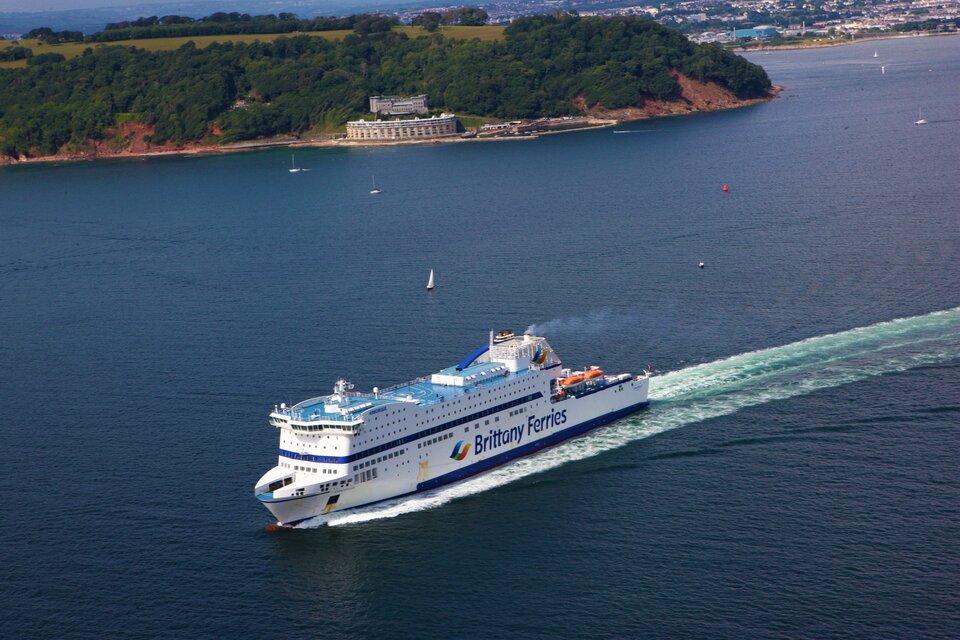
Primary route profile
Armorique
Armorique was designed for Brittany Ferries and particularly for the Plymouth–Roscoff route, joining the fleet in 2009. The operator gives capacity for up to 1,500 passengers and 470 cars and lists 247 air-conditioned, en-suite cabins. Public areas draw on Breton maritime culture and include indoor and open-deck space for a relatively short Channel passage or an overnight trip. Although Armorique is strongly associated with this corridor, operational substitutions are possible. Use the profile to understand the likely vessel, then confirm the ship and accommodation attached to the final booking.
- Up to passengers
- 1,500
- Up to cars
- 470
- Cabins
- 247
Pet context: Official accommodation information includes pet-friendly travel on most cruise ferries; verify Armorique’s current pet option and reserve it for the exact sailing.
Official sources and review date
Facts reviewed 2026-08-11.
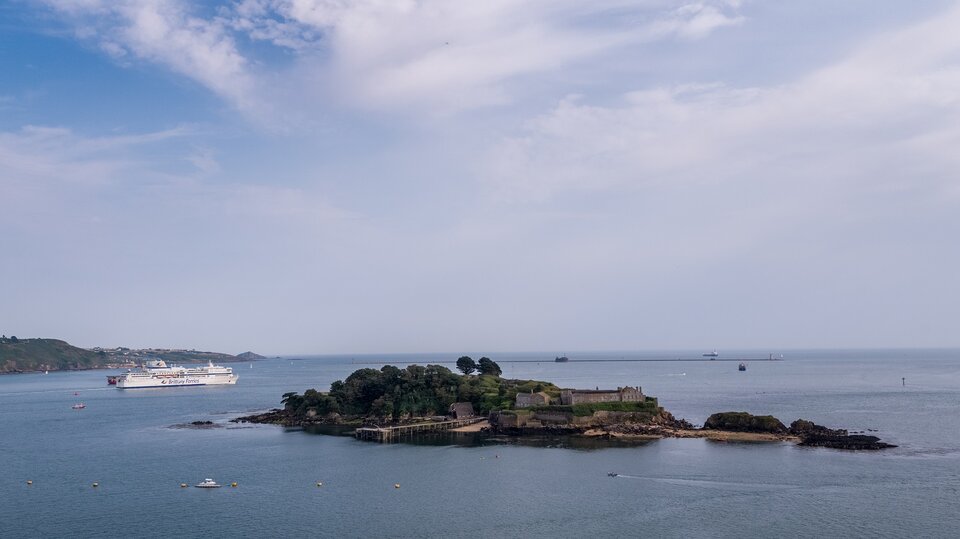
Also commonly used
Pont-Aven
Pont-Aven is Brittany Ferries’ flagship cruise ferry and is used on services to both France and Spain. The operator publishes capacity for up to 2,400 passengers and 650 cars, giving a sense of its scale rather than a guarantee of space on a particular crossing. Accommodation runs from standard inside and outside cabins through Club, De Luxe and Commodore choices, with public areas suited to longer sailings. The ship can appear on different routes as schedules change. Treat Pont-Aven as a commonly associated vessel, then verify the operating ship and exact cabin features on the live booking.
- Up to passengers
- 2,400
- Up to cars
- 650
Pet context: Official listings include pet-friendly inside and outside cabins with laminate flooring; the selected pet cabin must be reserved and confirmed for the sailing.
Official sources and review date
Facts reviewed 2026-08-11.
Ships and schedules can change; check your booking for the operating vessel.
Landfall
Arriving in Roscoff
Roscoff gives quick access to northern Brittany and westbound routes towards Brest, with the town close to the terminal. Disembarkation and checks still shift the true road-departure time. Wait until safely outside the working port before stopping, then offer water and exercise before the longer drive. Roscoff is already well west in Brittany, saving road miles for Finistère. If travelling farther south or east, allow a dog break before leaving the coastal area.
Sources for route facts
- Brittany Ferries: Plymouth to Roscoff (reviewed 2026-08-11)
- Brittany Ferries: Plymouth port guide (reviewed 2026-08-11)
- Brittany Ferries: Roscoff port guide (reviewed 2026-08-11)
- Brittany Ferries: travelling with pets (reviewed 2026-08-11)
- GOV.UK: getting an animal health certificate (reviewed 2026-08-11)
Dogs aboard
Planning this ferry with a dog
A five-hour day trip and a long overnight sailing are genuinely different welfare choices. Plymouth allows dogs around the public port, so a proper walk before boarding is realistic.
- Documents
- GOV.UK advises GB residents to obtain an Animal Health Certificate from an official veterinarian for EU entry. It is issued before travel and has a limited entry window.
- Rabies and microchip
- Confirm the microchip record and a valid rabies vaccination against current GOV.UK guidance and the destination’s rules. EU pet rules changed in 2026, so do not assume an older EU pet passport issued in Great Britain is still accepted.
- At Plymouth
- Dogs are allowed in the public port areas, but pet passengers are asked to check in at least 90 minutes early.
- On board
- A five-hour day trip and an overnight sailing are different welfare choices. Confirm the pet facility on Armorique or Pont-Aven and match feeding and toilet breaks to the actual schedule.
- Muzzle
- Brittany Ferries requires a muzzle whenever the dog is outside the car, kennel or pet-friendly cabin. Practise with it before travel.
Border and carrier rules change. Confirm every item against the official sources listed above and your vet before you travel.
Questions
Frequently asked questions
How long is the ferry from Plymouth to Roscoff?
The useful planning figure is about 5¼ hours by day or roughly 8–11 hours overnight. Check the dated Brittany Ferries timetable because individual crossings can differ.
Which ship operates from Plymouth to Roscoff?
Armorique (Plymouth ↔ Roscoff) or Pont-Aven (Plymouth ↔ Santander / Roscoff) are associated with this corridor. Operational substitutions happen, so the ship shown on the booking is the one to use for cabin and pet-facility details.
Can I take a dog from Plymouth to Roscoff?
Pet travel is offered on relevant sailings, but the available arrangement varies by ship. Select a confirmed pet-friendly cabin, kennel or other offered option and follow current carrier and border rules.
What weather should I check for the Plymouth to Roscoff crossing?
Compare departure, mid-route and arrival conditions, especially wind, gusts, wave height and swell period. Forecasts are guidance only; the operator makes operational decisions.
Member alerts
Want the cabin before it becomes a public example?
Create a free account and set the exact direction, dates and accommodation you need — every new account starts with 3 days of Priority, no card needed. Alerts are delivered in priority order; a public route page is deliberately delayed.
Create an account and set alertsAlready a member? Log in to manage alerts.